How we work

From the first call to the last van.

Six steps. A floor plan and a line-item quote before you commit to anything. A schedule your priest, your planner and your photographer all hold a copy of. Nothing on your wedding day should be a decision.

The short version

No mystery.
No surprise invoices.

Most decor enquiries end with a number and no drawing. Ours end with a drawing first — then the number, broken into lines you can actually argue with.

The order of work is deliberate. Ritual, then venue, then sightlines, then flowers. We find out what your priest needs and what your venue forbids before anybody talks about palettes, because those two facts decide more of the design than taste ever does.

You are never asked to imagine it. By the time you sign, you have seen the mandap in elevation, the room in plan, and a written direction for every function of the weekend.

Telugu & Indian ceremonies Clifton Park, NY Est. 2022 Strike always included
What we design

At a glance

Full wedding weekend
9–12 months ahead
Single function
2–3 months ahead
First conversation
Free, no obligation
Concept to quote
About three weeks
What reserves a date
Agreement + retainer
Venue walkthrough
Final 30 days
Design lead on site
Every function
Strike & disposal
In every quote
There is no flat price list on this site, because there is no flat wedding. A 90-guest Seemantham in a living room and a 400-guest muhurtham in a ballroom share almost nothing except the person designing them.
Step by step

Six steps, and none
of them are a surprise.

This is the whole spine of the job, in order, with what you receive at each stage. Nothing here is held back for a sales call.

Week one

The first conversation

A call or a coffee. Which ceremonies, how many people, which venue, and — honestly — what the budget is. No moodboards yet. Just the shape of the weekend. If we are not the right studio for what you are planning, you will hear that here rather than in month four.

Free 45–60 minutes Video call or coffee
Week two

Concept & colour story

You get a moodboard, a palette and a written design direction for every function. If Friday is marigold and Sunday is plum, this is where we prove they belong to the same wedding. Most couples arrive with a Pinterest board full of contradictions; this stage exists to turn that into one coherent direction you can say yes to.

Moodboard per function Palette Written direction
Week three

Layouts & quote

Floor plans drawn against the real venue dimensions, a mandap elevation, and a line-item quote. You see exactly what each element costs before you commit to any of it. Line items matter: they let you cut one thing you can live without instead of shrinking the whole idea by twenty per cent.

Scaled floor plans Mandap elevation Line-item quote
On booking

Reserved & locked

A signed agreement and a retainer hold your date. From here the design is ours to worry about — sourcing, fabrication, rentals, permits and the venue's load-in rules. We can hold a date informally for about a week while you decide; after that it goes back on the calendar.

Signed agreement Retainer Date held
Final 30 days

The walkthrough

We walk the venue with you, confirm every timing against the priest's muhurtham, and hand your planner and photographer a final schedule so nobody is guessing. Power drops, the width of the load-in door, where the truck parks, which lift reaches the ballroom — all of it gets written down thirty days early instead of discovered at six in the morning.

Site visit Muhurtham check Vendor schedule issued
Event week

Build, host, strike

We load in, build, and stay on site through the function. When it is over we take everything down and leave the venue exactly as we found it. That part is included — it is usually a contractual requirement of the venue, and it is always ours to manage, not yours.

Load-in On-site design lead Strike included
Your side of it

Six things we need
from you

None of it is difficult. All of it is easier in month one than in week one — and every item on this list has, at some point, changed a design after it was drawn.

The venue contract

The whole thing, appendices included. Load-in windows, open-flame rules, what may touch the walls, whether anything at all can hang from the ceiling. That document quietly decides more of your design than your Pinterest board does. We would rather read it in month one than discover it at 6am on the day.

The priest's timings

The muhurtham, and how long he needs in the space before it. Everything we build is scheduled backwards from that one number. A mandap that is finished at 9:40 for a 9:30 muhurtham has failed, however good it looks in the photographs afterwards.

A guest count you believe

Not the optimistic number, and not the one that keeps the peace at home. Guest count sets table layout, aisle width, how far back the last row sits, and therefore how tall the mandap has to be to read from there. Tell us the moment it moves.

Outfit swatches

A photograph of the actual fabric in daylight — not a screenshot of the boutique's listing. Screens lie about colour, and a gold that reads warm on a phone can go green against ivory drape. A two-inch swatch in the post is better than any photograph.

Your vendor list

Planner, photographer, DJ, caterer, mehendi artist. We would rather email them in month two than meet them in a car park on the morning. Your photographer wants to know where the light falls on the mandap; your DJ needs to know what is behind the stage.

The dates, in one message

Every function, in order, with its venue and its start time. Friday Mehendi at the house, Saturday muhurtham at the hall, Sunday reception in the ballroom. Written down once so that nobody — including us — is working from memory.

The flowers come last. Ritual, then venue, then sightlines, then flowers. Change that order and you get a beautiful room that nobody can actually get married in.

Jyothsna Katari · Every detail matters.

A closer look

Three steps where
the work actually is

Steps two, three and five are where a wedding is won or lost. The rest is admin and lifting.

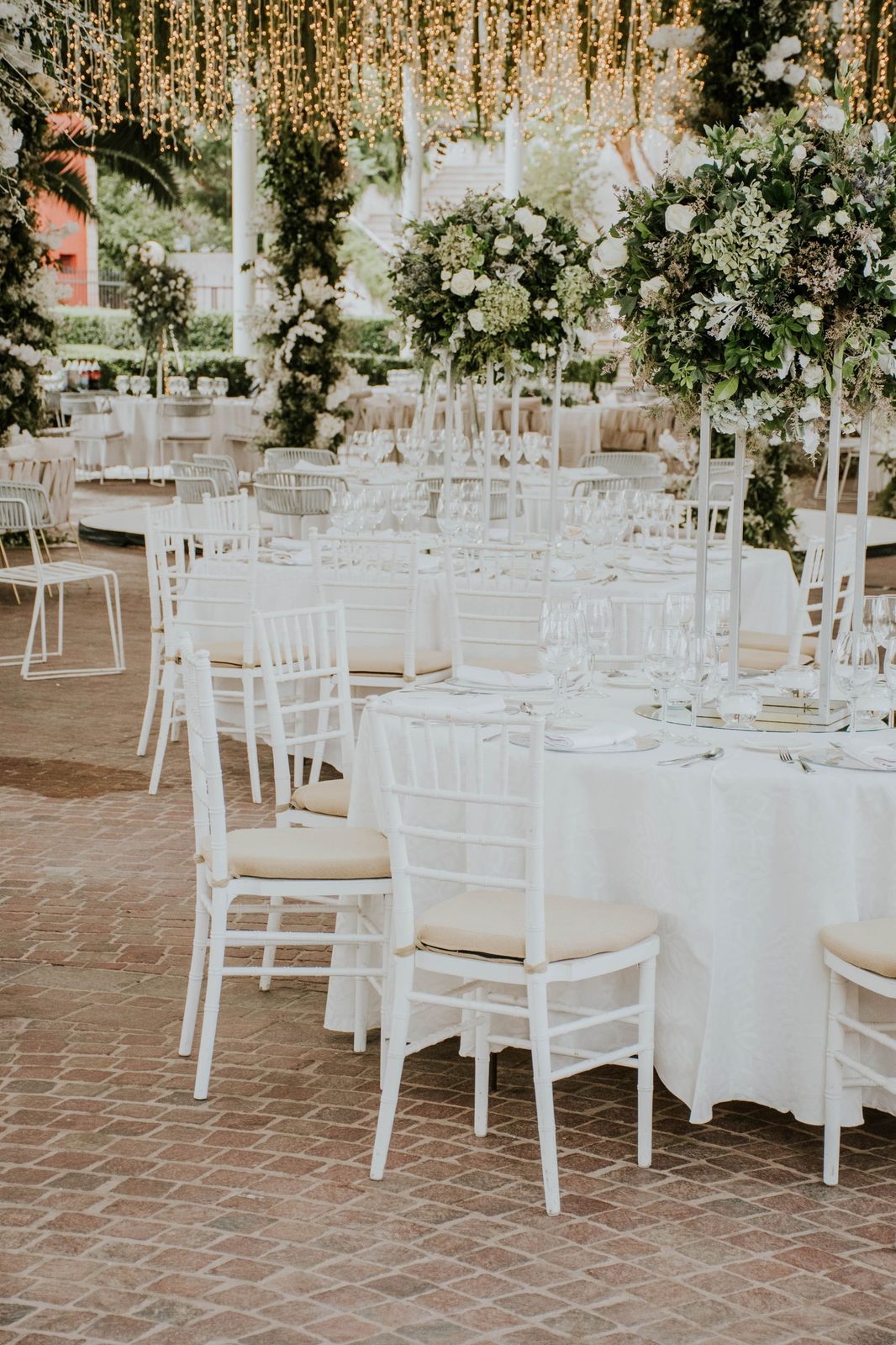
A banquet room dressed with white florals and hanging greenery
The drawing stage
Step 02

Building a colour story that survives three days

A palette is not a mood — it is a set of decisions about how three different rooms, in three different kinds of light, will look like one wedding. Friday's Mehendi is lantern-lit and low. Saturday's muhurtham is often full daylight through a wall of windows. Sunday's reception is tungsten and darkness.

So we pick a connective colour — usually one flower and one metal — that appears in all three and let everything else move. Marigold on Friday can become amber glass on Sunday and still read as the same hand. What we will not do is paste the same backdrop into three rooms and call it consistency.

  • One moodboard per function, not one for the weekend
  • Palette tested against your venue's actual light
  • Fabric decisions made before flower decisions
  • A written direction you can forward to any vendor
Step 03

Floor plans drawn against the real room

Venue marketing PDFs are optimistic. We measure — or we get the architectural plan — and we draw to that. Then we tape out the mandap footprint and stand at the back row, because a mandap that is beautiful from the third table and invisible from the twentieth is a design problem, not a photography problem.

An aisle needs to be wide enough for a bride in a heavy Kanjeevaram plus the people holding it. A priest needs room to sit, reach the fire and turn. Talambralu need somewhere for the rice to go. All of that is decided on paper, in week three, while it is still free to change.

  • Scaled plan of every room you are using
  • Mandap elevation with real heights
  • Sightlines checked from the back row
  • Line-item quote — cut a line, not the idea
Step 05

The walkthrough, thirty days out

We walk the venue with you and, wherever possible, with the banquet manager. Not to admire it — to measure the load-in door, find the power drops, check whether the service lift takes an eight-foot pillar, and learn where the truck is allowed to sit at half past five in the morning.

Then every timing is confirmed against the priest's muhurtham and a single schedule goes out to your planner, your photographer, your caterer and the venue. One document, one version, everybody working from the same page. By the time the day arrives there should be nothing left to decide.

  • Site visit with the venue's own manager
  • Load-in, lift and power confirmed in writing
  • Timings checked against the muhurtham
  • One schedule issued to every vendor
On the day

Hour by hour

Two real shapes of day, written the way we actually run them. Your schedule is built backwards from the muhurtham or the doors — never forwards from breakfast.

Example one

A morning muhurtham

Banquet hall, 300 guests, muhurtham at 10:12am.

5:30 am
Truck leaves the workroom
6:00 am
Load-in, walk with the manager
6:45 am
Mandap frame up and levelled
7:30 am
Draping, canopy, pillars dressed
8:15 am
Fresh flowers on — always last
9:00 am
Kalasham, pooja staging, family chairs
9:20 am
Priest checks his own space
9:40 am
Aisle, entrance and photo corner
10:12 am
Muhurtham. We stand at the back
2:00 pm
Strike begins
4:00 pm
Venue handed back
Example two

An evening reception

Ballroom, 400 guests, doors at 6:30pm.

11:00 am
Load-in once the room clears
12:30 pm
Ceiling drape and rigging signed off
2:00 pm
Stage, backdrop, couple seating
3:30 pm
Uplights placed and focused
4:30 pm
Tables, centrepieces, sweet table
5:15 pm
Photographer walkthrough
5:45 pm
Entrance and foyer dressed
6:10 pm
Lights taken down to warm
6:30 pm
Doors
11:30 pm
Strike begins
2:00 am
Keys back to the venue

Both of these are typical, not promised. A home Pellikuthuru compresses the whole thing into six hours; a three-day weekend runs a version of it every morning.

No line for it, because it is not optional

What is always
included

These do not appear as extras at the bottom of a quote. They are the job.

In every quote

  • Design fee and concept work
  • Floor plans and elevations
  • Delivery, load-in and load-out
  • Labour to build and dress
  • Damage-free fixings and weights
  • Strike, disposal and clean-up

On site, every function

  • A named design lead who stays
  • A crew sized to the room, not the invoice
  • A steamer and a repair kit
  • Spare stems and spare fabric
  • Somebody watching the clock
  • A phone that gets answered

After the last guest

  • Full strike, same night where the venue requires it
  • Rentals returned on our clock, not yours
  • Floors swept, venue handed back
  • Fresh garlands boxed for the family
  • Anything of yours returned next day
  • An honest note on anything that slipped
The honest part

What can go wrong,
and what we do about it.

Every one of these has happened to somebody. None of them ruined a wedding, because each one has a plan attached to it long before the week of the event.

Venue restriction

“No open flame.”

Hotels say it more often every year, and a Telugu wedding has fire at the centre of it. We read the contract in month one and go to the venue's fire officer rather than the sales manager — a sanctioned metal vessel, a sand tray and an extinguisher will usually pass where a loose diya will not. Everywhere the flame is decorative rather than ritual, it becomes LED, and it is chosen well enough that nobody at the third table can tell.

Venue restriction

“Nothing may hang from the ceiling.”

Then the structure has to carry itself. Free-standing rigging, weighted uprights, a canopy that takes its own load. It costs more and it takes longer to build, so it goes into the quote at week three — as a line you can see — instead of arriving as a change order in month eight.

Timings

The muhurtham moves

Priests recalculate, and sometimes the answer changes. Every build is sequenced so the ceremony core — mandap, fire, family seating — is finished a clear forty-five minutes before the stated time. A shift of an hour or two is absorbed without anybody noticing. A move to a different day is a real conversation, but it is a conversation, not a catastrophe.

Weather

Rain on an outdoor Haldi

The wet plan is agreed at the walkthrough, not at six in the morning. A covered footprint is identified, marigold and mirror-work are specified to survive water anyway, and the platform is built so it can be hosed down. The call gets made by a fixed hour so your caterer, your photographer and your grandmother all hear it at the same time.

Logistics

The function before you runs late

Banquet-hall turnarounds are brutal and they are rarely your fault. We pre-build off site, work in modular sections that go up in a fixed order, and size the crew to the window the contract actually gives us rather than the one we would like. If the window shrinks, the flowers still go on last — that order is what protects them.

Scope

The guest count jumps by sixty

Centrepieces and seating scale easily. A mandap does not, and neither does an aisle. Tell us the day you know: the layout gets redrawn, the quote gets revised in writing, and you approve it before anything is ordered. Nothing is ever added to your invoice without you seeing it first.

What we will not do is tell you something is fine when it is not. If an element will not work in your venue, you hear it in week three, on the phone, with an alternative already drawn.
Step one takes an hour

Let’s have the
first conversation.

Send the dates, the venue if you have one, and which ceremonies you are planning. You will hear back within one working day — and there is no charge for the concept discussion.